



For more than 45 years, TalentTeam has placed talent in manufacturing, distribution, and operational environments. That experience has taught us one thing above all others:
We own the quality of the new talent. You own the quality of the employee experience.
Both have to be intentionally cultivated. One won’t succeed without the other.
That’s why we developed a simple, practical framework to help organizations manage the early employment period deliberately, converting new talent into productive contributors faster, and building a workforce that gets stronger over time

Most workforce problems start in the first few weeks — not six months in.
The early employment period is where workforce outcomes are actually determined. Attendance patterns form quickly. Performance trajectories establish themselves. Cultural fit — or the lack of it — becomes a problem long before it shows up in turnover data.
Most organizations recognize the pattern. Few have optimized the process for addressing it during the window when intervention still matters. Not because they lack commitment — but because deliberately managing new talent through early tenure requires a defined process that most are still refining.
Without that process, supervisors make independent judgment calls with no common standard. Promising new talent doesn't get the early reinforcement that accelerates development. Unsuitable employees linger longer than they should. And the stable, high-performing workgroup that every operation needs stays just out of reach.
The first few weeks aren't an onboarding formality. They are the highest-leverage opportunity in the entire employment lifecycle.

Every new hire enters on the wrong side of the productivity line. The question is how intentionally you manage that journey
Every new employee arrives with potential. But potential doesn’t generate output on day one.
In the early weeks, a new hire is consuming resources — supervisor time, training investment, production capacity — while contributing well below the level they were hired to deliver. There is a knack to every job, and the new talent doesn’t have it yet
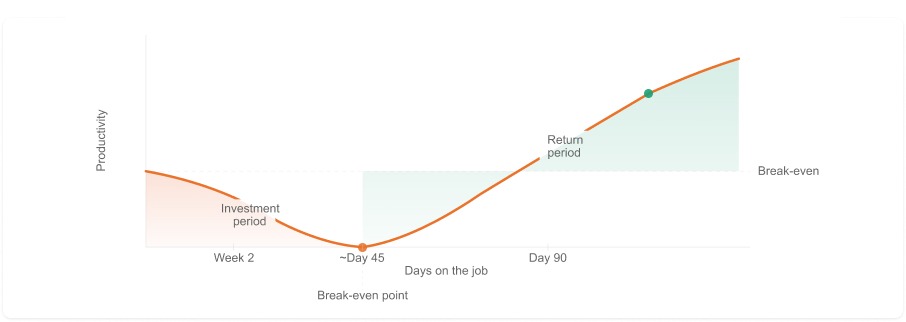
Think about how a manufacturer approaches a new piece of capital equipment. Nobody expects it to generate return on day one. There’s a commissioning period — calibration, debugging, adjustment — before it reaches the expected run rate. The investment is managed deliberately through that period because the outcome matters too much to leave to chance.
New talent works the same way. Every new hire follows a predictable investment path — early losses before the break-even point, then productive contribution, then the kind of seasoned performance that generates real return. The speed and reliability of that transition isn’t accidental. It’s a management outcome.
It starts with excellent talent. But talent alone doesn't build a stable, productive workforce. That requires intentional cultivation
Finding the right person for a role is where the staffing relationship begins. It is not where workforce success is determined
Every placement TalentTeam makes starts with deliberate sourcing and careful screening — matching talent not just to a job description but to the specific environment, pace, culture, and expectations of the operation they are entering. That selectivity matters enormously. It is the foundation everything else is built on.
But even the most carefully selected new employee arrives with two things still unproven: whether they will develop the knack for the job, and whether they will become a genuine contributor to the culture around them.

Productivity

Cultural Fit
Those two things — productivity and cultural fit — are not discovered on a resume or confirmed in an interview. They reveal themselves during the early weeks of employment, under real conditions, with real supervisors, doing real work.
That reveal doesn't happen on its own. It has to be cultivated.
When the early employment period is managed with intention — when supervisors are observing consistently, when promising talent is reinforced early, when poor fit is identified before it becomes an expensive problem — the investment in finding the right person pays off. When it isn't, even strong candidates can quietly fail.
This is the shared responsibility at the center of every successful staffing relationship. TalentTeam owns the quality of the new talent. The organization owns the quality of the employee experience. Both have to be intentionally cultivated. One won't succeed without the other.
Sound complicated? It isn't. We have spent years developing a simple, practical system that makes the cultivation process easy to implement, easy to sustain, and consistently effective. It doesn't add bureaucracy. It doesn't burden supervisors. It just works.
Book a Short Strategy Call
The TalentTeam Yield System. Simple. Practical. Already working
Everything described in the previous sections — the early employment window, the investment path, the intentional cultivation of productivity and cultural fit — is the foundation of a structured framework we call the TalentTeam Yield System.
It is built around one central idea: that new talent should be managed through the early employment period with the same intentionality an operation brings to any other critical resource investment.
In practice it comes down to two questions asked about every new employee during their first ninety days:
- Are they developing the knack for the job — becoming productive enough to be an actual resource?
- Are they a genuine fit for the culture — contributing positively to the people and environment around them?

Monthly Check-in
Supervisors closest to the work rate each new employee once a month — in a short, simple conversation. No lengthy reviews, no complicated forms. Just a guided scale and shared observations.
Common Standard
That conversation creates a common standard across all supervisors. It surfaces early signals before they become expensive problems — and forces the right decisions while there's still time to act.
Data Tracking
TalentTeam tracks every placement — monthly ratings, tenure outcomes, and reasons behind every departure. Patterns emerge that no single supervisor can see alone, so you always know where the process is working.
When this works consistently, the workforce stops being unpredictable and starts becoming your most reliable competitive advantage
The organizations that manage the early employment period with intention don't just see lower turnover. They see something more valuable accumulate over time.

Warren Buffett describes a sustainable competitive advantage as a moat — something that protects the business from competition in a way that is difficult to replicate or erode. Like an alligator-filled moat around your castle. A stable, high-performing workforce built through years of intentional management is exactly that kind of moat.
You can copy a competitor's pricing. You can replicate their equipment. You cannot quickly replicate the behavior, culture, and institutional knowledge of a workforce that has been carefully built over time.
Let's talk about what this looks like in your operation
Every operation is different. Different supervisors, different environments, different workforce challenges. The TalentTeam Yield System is designed to work within your reality — not around it.
If what you've read here connects with what you're experiencing, we'd welcome the opportunity to have a straightforward conversation about your workforce goals and whether our approach makes sense for your organization.
No pressure. No pitch. Just a practical conversation between people who care about building something that works.